The MCP Server Explosion: Why More Servers Isn't Better
The MCP ecosystem now has thousands of servers, but quantity brought a quality crisis. Most are naive API wrappers, abandoned, or insecure. It needs curation, not more servers.
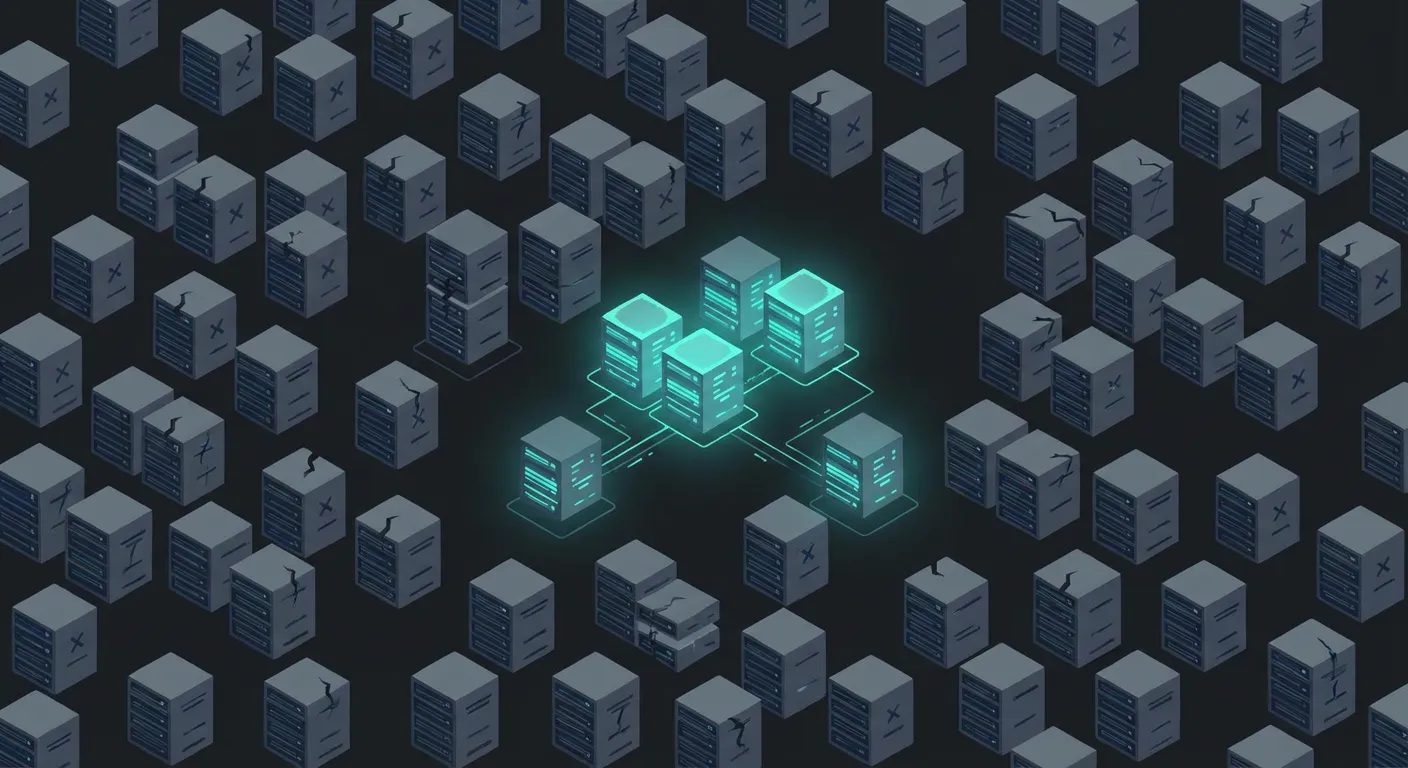
The Model Context Protocol ecosystem is growing faster than anyone predicted. MCP now has over 97 million monthly SDK downloads. Every major LLM host — Claude, ChatGPT, Cursor, Codex CLI, Amazon Bedrock — speaks it natively. The official registry alone holds close to 2,000 servers, and the broader ecosystem spans thousands more across GitHub, npm, and community directories.
This is what winning looks like for a protocol. It’s also what a quality crisis looks like for everyone building on it.
The growth is real
MCP crossed a threshold in 2026. The Linux Foundation adopted it. OpenAI, Google, Microsoft, and Amazon all integrated it. The shift from “Anthropic’s protocol” to “the industry standard” happened in months, not years.
The numbers tell the story:
- 97M+ monthly SDK downloads — more than most programming languages’ core tooling
- 2,000+ servers in the official registry — thousands more in the broader ecosystem
- Every major AI coding tool now supports MCP connections natively
- A major protocol release landing July 28, 2026 — stateless core, first-class extensions, improved authorization, and W3C Trace Context propagation
The velocity is real and accelerating. But velocity without quality control creates a predictable problem: most of what’s being built isn’t production-ready.
The quality problem
Spend an afternoon browsing MCP server repositories and you’ll see the same patterns over and over. Most servers fall into one of four failure modes:
Naive API wrappers. Take a REST API. Wrap each endpoint as an MCP tool. Publish it. This is the anti-pattern ThoughtWorks flagged on their Technology Radar — and it’s the most common pattern in the ecosystem. (For a concrete breakdown of the five most damaging mistakes, see 5 MCP Server Mistakes That Make Your AI Agent Worse.) The problem isn’t that it “works.” The problem is that an LLM doesn’t need 47 CRUD endpoints exposed as tools. It needs a curated set of capabilities designed for how language models actually reason. Dumping every endpoint into a tool list overwhelms the model’s context window and produces worse results than a focused, purpose-built interface with five well-designed tools.
Abandoned repos. Published once, never updated. The upstream API changes, the server starts returning errors or stale data, and nobody notices because nobody’s maintaining it. This is the npm “left-pad” problem applied to AI tooling — except when a documentation server silently serves outdated information, the failure mode isn’t a build error. It’s a hallucination that looks correct. Your AI agent confidently uses a deprecated API because its MCP server still says it exists.
Security gaps. The OWASP MCP Top 10 exists for a reason. Over 40 CVEs were disclosed against MCP implementations in the first four months of 2026 — roughly one every four days. OX Security found remote code execution vulnerabilities in Anthropic’s own official SDKs. Independent research shows that 36.7% of MCP servers are vulnerable to server-side request forgery. Most servers request broad permissions they don’t need, violating the principle of least privilege — or what the MCP community is now calling the “least agency” principle for AI systems.
Missing context. A tool that calls an API and returns raw JSON isn’t grounding — it’s delegation with extra steps. The LLM receives a blob of data it wasn’t designed to parse and guesses at what’s relevant. Good MCP servers structure their responses for LLM consumption: summarized, labeled, and scoped to what the model actually needs for the task at hand. Most servers don’t do this. They return whatever the upstream API returns and hope the model figures it out.
These aren’t edge cases. They’re the majority of what exists. The ecosystem has a breadth problem disguised as a depth advantage.
What good looks like
Strip away the noise and the best MCP servers share a few clear characteristics:
- Purpose-built for LLM consumption. Tools return structured, relevant responses — not raw API dumps. A documentation server returns the specific section that answers the query, not the entire page. A database server returns a summary with the relevant rows, not a JSON blob of everything.
- Actively maintained. The upstream data source changes, and the server updates to match. Version numbers are meaningful. Breaking changes are documented. There’s a changelog and somebody reads it.
- Minimal permissions. The server requests only the access it needs. A documentation server shouldn’t need write access to your filesystem. A search tool shouldn’t need your GitHub token with repo deletion scope.
- Clear documentation. What does this server do? What are its limitations? What data does it access? What permissions does it need? If you can’t answer these questions from the README, the server isn’t ready for production.
- Pre-built and curated. Instead of expecting every developer to build their own documentation pipeline from scratch, good ecosystems ship pre-built packages that are tested, versioned, and ready to use.
The ratio of servers meeting all of these criteria to the total ecosystem count is not encouraging.
The curation thesis
The MCP ecosystem doesn’t need more servers. It needs better ways to find the good ones — and better defaults for the ones being built.
Three curation models are emerging, and the ecosystem will likely need all of them:
Centralized registries with quality gates. The MCP team is building official registry tooling with standards for metadata, discoverability, and eventually quality signals. This is the app store model — a single directory with review processes and quality baselines. It helps with discovery, but it scales slowly and can’t evaluate whether a tool’s responses are actually useful for an LLM.
Curated package ecosystems. Instead of pointing developers at raw server repositories and hoping for the best, offer pre-built, tested, versioned packages they can install directly. This is the approach @neuledge/context takes with its community registry — 150+ documentation packages covering React, Next.js, Django, Spring Boot, and dozens more, each indexed and packaged as a SQLite database for instant local search. You don’t clone a repo, configure API keys, or debug a build. You run context install npm/react 19 and get sub-10ms documentation access with zero network dependencies. The curation happens at the package level, before the developer even touches it.
Community vetting. Stars, downloads, usage metrics, independent reviews. This is how npm and crates.io matured — community signal gradually replaces the need for centralized quality control. For MCP servers, this layer is still nascent. Download counts exist but don’t distinguish between “someone tried it” and “someone uses it in production.” The quality signals developers rely on for npm packages haven’t been built for MCP servers yet.
The pattern is familiar because it’s the exact evolution npm went through a decade ago. Early npm was “publish anything, install at your own risk.” Over time, community curation, security auditing (npm audit, Snyk), and curated alternatives filled the quality gap. MCP is in its early npm phase, and the teams investing in curation now will define the ecosystem’s quality floor.
Before you install another server
The next time you’re about to add an MCP server to your stack, run it through this checklist:
- When was the last commit? If the repo has been dormant for 6+ months, the upstream integration it wraps has probably changed. You’re inheriting silent drift.
- How many tools does it expose? If the answer is “one for every API endpoint,” it’s a naive wrapper. You want purpose-built tools designed for LLM consumption, not an API surface dump.
- What permissions does it request? Check the README and configuration. If it needs broad filesystem, network, or API access for a narrow task, the attack surface is wider than it needs to be.
- Is the response structured for LLMs? Try the server and look at the raw response. Is it a wall of unstructured JSON, or is it formatted, scoped, and labeled for model consumption?
- Is it maintained by someone with skin in the game? A server backed by the team that builds the upstream product — or a community with active contributors — is more likely to stay current than a weekend project.
The MCP ecosystem is valuable because of what it enables — standardized, cross-client tool integration that works across Claude Code, Cursor, and every other MCP-compatible tool. But “it works with MCP” is a connectivity claim, not a quality claim. The protocol is solid. The average server built on it is not.
The explosion was necessary. Now comes the harder part: making what exists actually good.
Ready to try MCP servers that are curated, versioned, and built for production? @neuledge/context ships 150+ pre-built documentation packages you can install in one command. Get started in 2 minutes, or browse the integrations page to connect it to your AI coding tools.